

Clarity for engineering leaders. Confidence in the decisions that shape delivery.

Work with me to align teams around what really matters: organisational clarity, lower cognitive load, faster flow of value
Delivery shouldn’t feel this hard. If you’re facing rising costs, overloaded teams, and constant pressure to move faster, I help you make the invisible, visible to uncover the friction holding you back — and make targeted improvements that actually work. No jargon or big transformations, just evidence, clarity, and practical steps that reduce friction and improve flow of value.
The CTOs, CPOs and leadership teams I work with want fewer dependencies, lower cognitive load, and a system that actually fits the work. I help them get there by offering practical, evidence-based guidance tailored to their organisation.
Mapping user needs to make them visible and unambiguous
Reducing friction across teams and decision paths
Optimising team boundaries and interactions to support fast, sustainable flow of value
Building shared clarity so teams can make confident decisions
Creating a system that adapts as your products and platforms evolve
Trusted by




The symptoms are visible, the cause is harder to see
If you’re a CTO or engineering leader, this may feel familiar:
Work takes longer than it should, but no one can quite explain why
Quarterly planning exposes the same dependencies again and again
Teams are smart and motivated — yet constantly overloaded
Fixing one problem seems to uncover three more
Improvement ideas compete, but none feel clearly “right”
Leadership wants faster, cheaper delivery, without destabilising teams
You know something is getting in the way — but it’s hard to see
You’re not alone. These aren’t people problems, they’re system problems - and systems can be made visible.
See the real system, remove the friction, deliver with confidence
Leaders bring me in when they need:
A clear picture of how work really moves across teams: a shared view leaders and teams can align around
Insight into what’s slowing delivery down
A way to reduce cognitive load without burning people out
Better team boundaries and interactions, aligned with user needs, not just tech functions
Evidence to support confident decisions
A shortlist of targeted improvements to deliver the highest impact
Practical support as teams adopt healthier ways of working
A more adaptive organisation with energy and focus restored to teams - a workplace where your best people want to stay and contribute.

Extended Sessions Now Available! Flow Awareness: Preparing for AI
Flow Awareness Sessions
If you’re unsure where to begin, Flow Awareness Sessions can provide a focused, low-risk way to make hidden constraints visible and identify meaningful next steps.
Help your people see what’s slowing them down, give them the language to talk about it, and the confidence to fix it.


About me
I’ve spent the last two decades working in and alongside complex product and technology organisations — as a software engineer, tech lead, and founder — helping teams navigate growth, complexity, and change.
I’m a long-standing Team Topologies Valued Practitioner, and one of the earliest contributors to the development and teaching of Team Topologies. I helped shape many of the materials now used in Team Topologies training and consulting worldwide.
Alongside my consulting work, I’m an active speaker and writer, sharing practical perspectives on organisational design, flow, and team interactions through talks, workshops, and long-form writing.
My work is grounded in real organisations, real constraints, and a belief that good design should make work easier for the people doing it.
User Needs Mapping

Research by DORA shows that teams who focus on the user have 40% higher organisational performance and significantly higher job satisfaction. My experiences reflect this: the organisations who struggle most lack a shared, outside-in view of who they serve and what really matters.
I created User Needs Mapping as a practical technique for making user needs visible and reasoning about how teams, capabilities, and decisions should align around them.
User Needs Mapping helps organisations:
See their landscape from the outside-in
Distinguish real needs from internal activity
Reason about team boundaries and interactions
Make better structural and prioritisation decisions
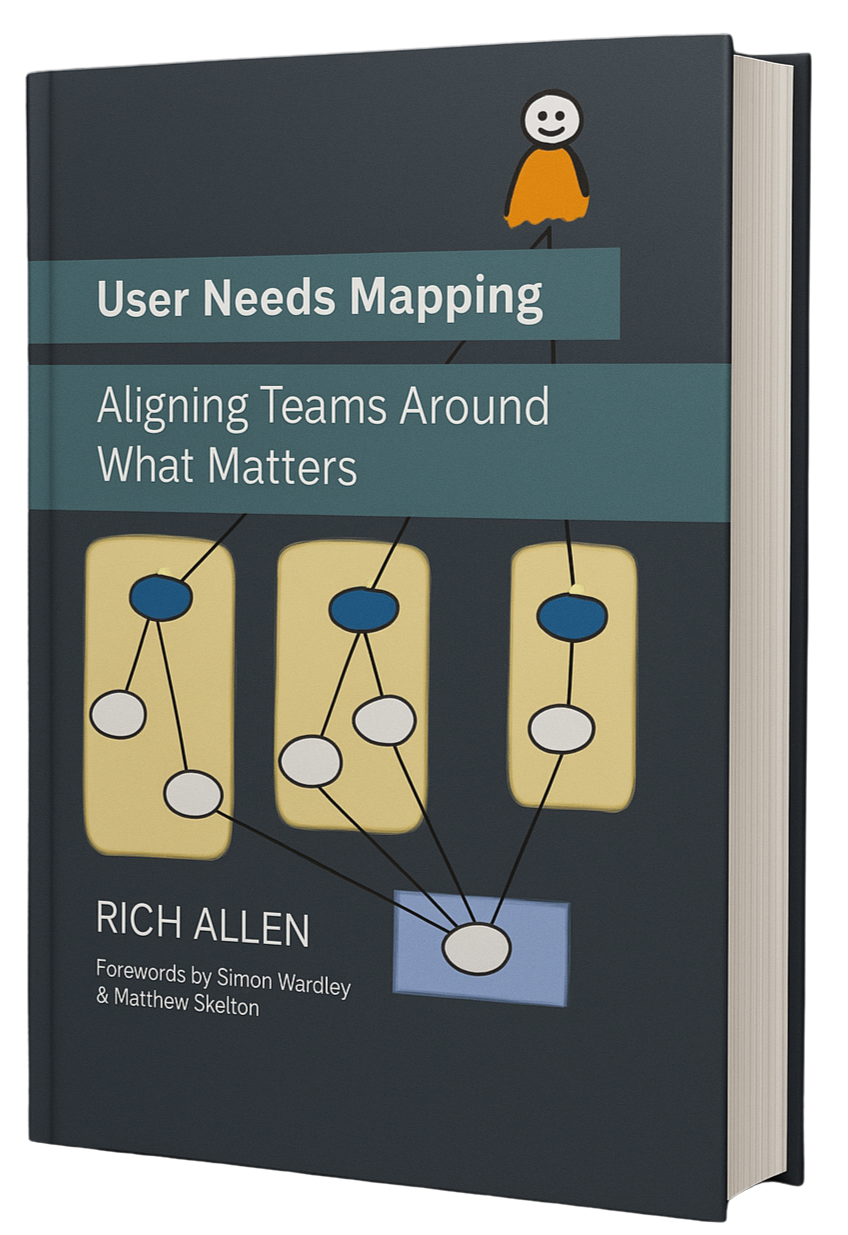
My book User Needs Mapping: Aligning Teams Around What Matters sets out patterns, practices, and guidance drawn from years of hands-on experience.